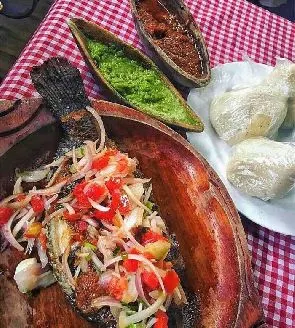
Today on the food blog we’re ditching the cutlery to embrace the finger licking delight of Banku and tilapia.
Banku is a local Ghanaian dish prepared by mixing a proportionate amount of fermented corn dough and cassava dough. These dough types are mixed together in hot water in a consistency that favours the maker. That sounds like a whole lot of starch and carbs if you ask us but banku has more to offer.
The corn dough dishes out some fibre, minerals and magnesium together with complex carbs. The cassava dough is rich in starch which is good for the body, in the right proportions of course.
Banku can be served with soups and stews alike. Today we delve into the most popular way of serving this delicacy; with grilled Tilapia, accompanied by some grounded hot pepper.
Ingredients to use
Fresh large sized Tilapia
Natural spices for seasoning your Tilapia (ginger,garlic, rosemary, cloves etc)
Corn dough
Cassava Dough
Salt to taste
Fresh Tomatoes and pepper
Bulb onions
Follow this procedure
Start off with your Tilapia
Clean your Tilapia, descale it and spice it with your preferred natural spices. Leave for some minutes for the fish to be well seasoned. (well well). Then put on the grill and into the oven.
From time to time, be glazing the fish with oil and turning as and when needed so as to not get stuck on the grill or burning, and get well cooked.
Make sure your hands are thoroughly clean before you begin with the banku. Mix and mash your portions of corn and cassava dough in a pot of water, making sure to take out all lumps and fibre pieces in it.
Do this until the mixture is paste-like, with an extremely smooth consistency Add a pinch of salt.
Put your paste on fire and stir with your wooden stirrer (banku ‘ta’). Stir gently until it starts to thicken.
With time, it gets thicker and thicker and gathers at the bottom of the wooden stirrer. You would have to apply more force here as it gets harder with time.
Reduce the heat, hold the pot in place with a napkin or sackcloth and start to beat through with the wooden spoon. Do this for about 6 minutes with brief stops in between
Use the wooden spoon to create perforations in the thick mass, add water, increase the fire and cover to cook.
By now your Tilapia should be ready or almost ready. Keep glazing and turning intermittently.
Wash your fresh tomatoes, pepper and bulb onions. Grind as many as you would prefer in an earthenware masher (Some like theirs hot, others not so hot) slice some onions on the side. Salt to taste.
Check on your banku and make sure the water does not fully dry up. Repeat the kneading process until smooth.
When smooth to your satisfaction, use a smaller bowl to shape the banku into preferred serving sizes.